%201.avif)
Choosing the Tougher Road: Max Herman’s Journey From Texas to the Midwest
For three years Max Herman chased the Texas podium and fell just short. Then he left for the Midwest and one of the country's toughest wrestling rooms.
BY
Ranked Texas
February 24, 2026
5 min read
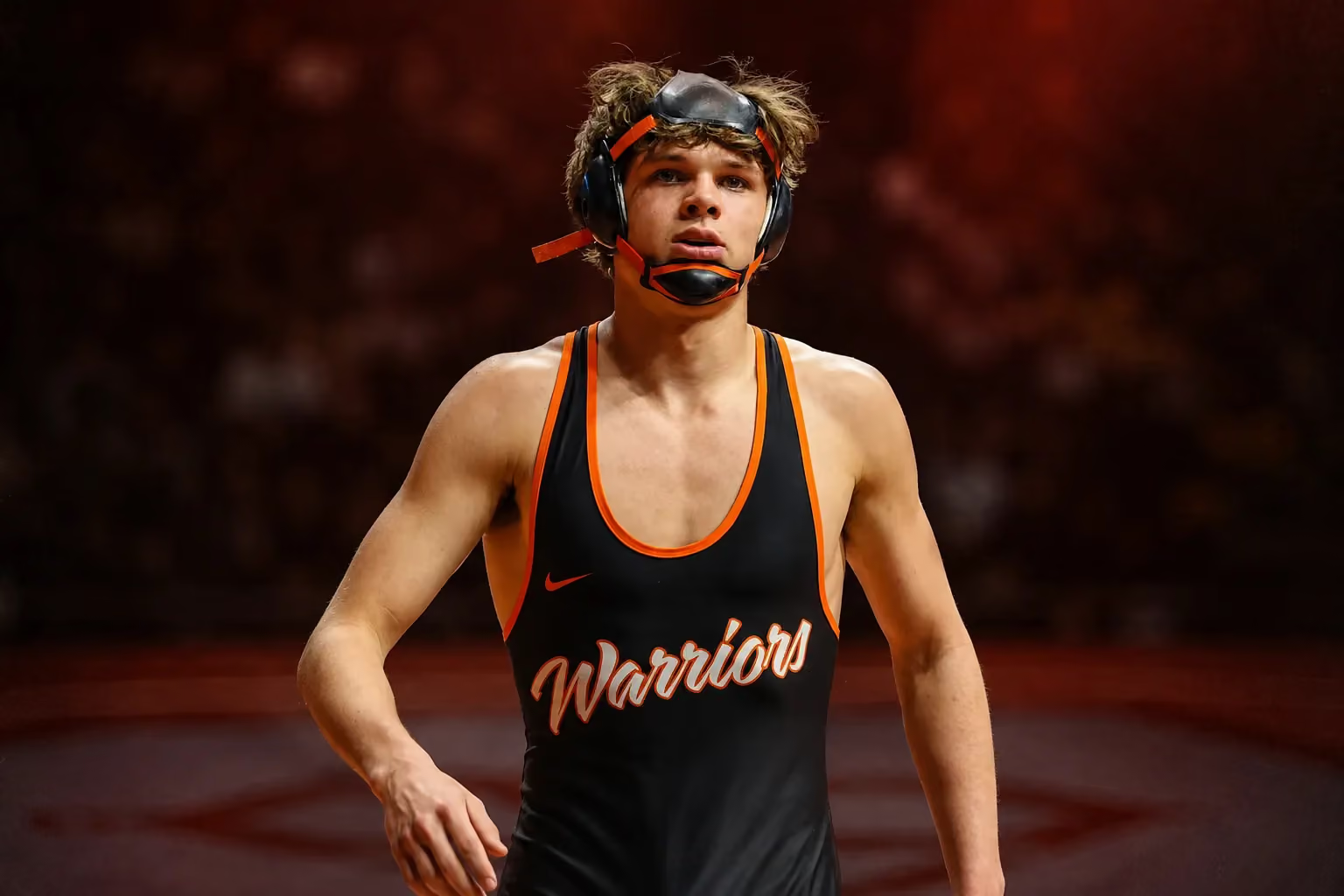
For three years, Max Herman chased the podium in Texas.
He qualified for the UIL State Wrestling Tournament three times while competing for Cinco Ranch High School in Katy, repeatedly putting himself in position to medal — and repeatedly falling just short. The margins were thin. The work was real. But the breakthrough never came.
Then, before his senior season, Max made a decision that would change everything.
He left Texas.He left familiarity.And he stepped into one of the toughest wrestling environments in the country.
Illinois wrestling carries a reputation built on depth, pace, and a long-standing Midwest tradition. State brackets are loaded with nationally ranked wrestlers, and podium finishes often come against athletes already committed to the top college wrestling programs in the country. That was the environment Max entered for his final year of high school wrestling — and by season’s end, he did what he had never done before.
He stood on the state podium.
Choosing Discomfort on Purpose
The move to Illinois wasn’t accidental, and it wasn’t impulsive.
“Several factors led me to leave the environment in which I was comfortable in,” Max said. “I had an epiphany when I didn’t place last year, in particular, when I lost in the blood round. I knew that something needed to change with my training habits.”
With only one season left, Max felt urgency.
“I knew I only had one year remaining to accomplish two goals — winning a high school state championship and preparing myself to wrestle at the next level in college.”
When his father had an opportunity to transfer to the Midwest, Max didn’t hesitate.
“I embraced leaving my comfort zone,” he said. “The Midwest is notoriously known as the mecca for outstanding wrestling.”
That decision was grounded in perspective. Max comes from a family that understands the demands of elite athletics.
“I am fortunate to have a brother and parents who were all Division I athletes and could give me advice on what the next level challenges might be.”
Earning His Place at Lincoln-Way West
Walking into a new room for one final season is never easy — but Max found himself in a program built to develop competitors.
“Lincoln-Way West High School has a tradition of excellence in both academics and athletics,” he said.
The support started immediately.
“Off the mat, I met with Lincoln Way West Principal, Dr. Robbins and my counselor, who immediately helped ensure my path to graduation and staying involved in things like National Honor Society.”
On the mat, there was no easing in.
“I was put straight to work. My teammates set the standard and created a perfect environment for me to be successful.”
Training partners played a major role.
“Jack Strezo and Max Munn were my primary training partners, both giving me a different feel day in and day out. Brady Glynn was there for me on the mat and was a big part of getting me involved in the day-to-day life at LWW.”
The coaching staff identified what needed to change.
“Head Coach Brian Glynn and Assistant Coach Justin Farmer identified my wrestling weaknesses through watching me compete, film study, and practice habits, and they helped correct those problems with the assistance of a highly qualified coaching staff — including Coach Mick, Mark, Josh Ruettiger, Javen Estrada, Matt Ryan, Ricky Olstza, and Mike Migawa.”
Thrown Into the Fire
Illinois didn’t give Max time to adjust.
“Every single tournament, I competed against someone who was a state champ or placer,” he said. “I was thrown into the fire in Illinois.”
The learning curve was immediate.
“In my first tournament, I wrestled the #1 and #2 place finishers from the 165-pound bracket.”
The schedule was relentless.
“Our team competed in several prestigious tournaments like the Dan Gable DonnyBrook Invitational.”
And the day-to-day grind demanded more.
“I had to get more intense with my hand fighting. Each day after practice, Coach Migawa and I would work on that together.”
Adjusting to Medal-Level Wrestling
Success in Illinois required change — both physically and mentally.
“Physically, I had to quickly make some adjustments,” Max said. “I worked on baseline defense, positioning shots, and becoming better on all three positions — top, bottom, and neutral — because most competitors here are good at all three.”
Mentally, the shift was just as important.
“The first thing I had to accept was that where I started in Illinois wasn’t where I was going to finish.”
Support mattered when the pressure peaked.
“Coach Matt played an important role. He would make sure my mind was good before each match and that I was confident in my abilities in the big moments.”
Texas Still Built the Foundation
Even though the breakthrough came in Illinois, Max is quick to credit his years in Texas.
“Cinco Ranch has a solid history of developing wrestlers,” he said. “I knew the importance of solid training partners.”
Those rooms mattered.
“Guys like Dale Box, Richie Walsh, Vince Echavarry, and of course my brother Jackson always pushed me hard.”
So did the club system.
“Having a great club like WAR Training Center was important in my development. Coach Kyle and Coach James were dedicated to making us better wrestlers.”
“When the whistle blew, it all hit me.”
The breakthrough moment came in the blood round at the IHSA State Tournament in Champaign, where every position, every exchange, and every second carries weight.
“I was overwhelmed when I won my blood round match against a tough opponent whom I had wrestled several times previously,” Max said. “I had lost to him the week before at Sectionals in double overtime, so that added to my emotions.”
When the final whistle blew, reality set in.
“At that moment, I realized my goal of placing in Illinois had come true and that the sacrifices were worth it.”
After years of chasing the podium in Texas, Max had finally broken through — not by taking an easier path, but by choosing a harder one.
Completing the Legacy
Now, with his high school career complete, Max sees the journey clearly.
“It means the Herman legacy is complete,” he said. “Everything I worked for — the chance I took — paid off.”
And there’s one final detail that brings it full circle.
“I can now say that I medaled in the same place as my dad did 33 years ago.”
TRENDING ATHLETES