%201.avif)
Quietly Climbing: Gianna Zavala’s Rise at Langham Creek
The Langham Creek standout went from a .500 sophomore season and missing regionals to finishing third in all of Texas as a junior.
BY
Ranked Texas
September 7, 2026
7 min read
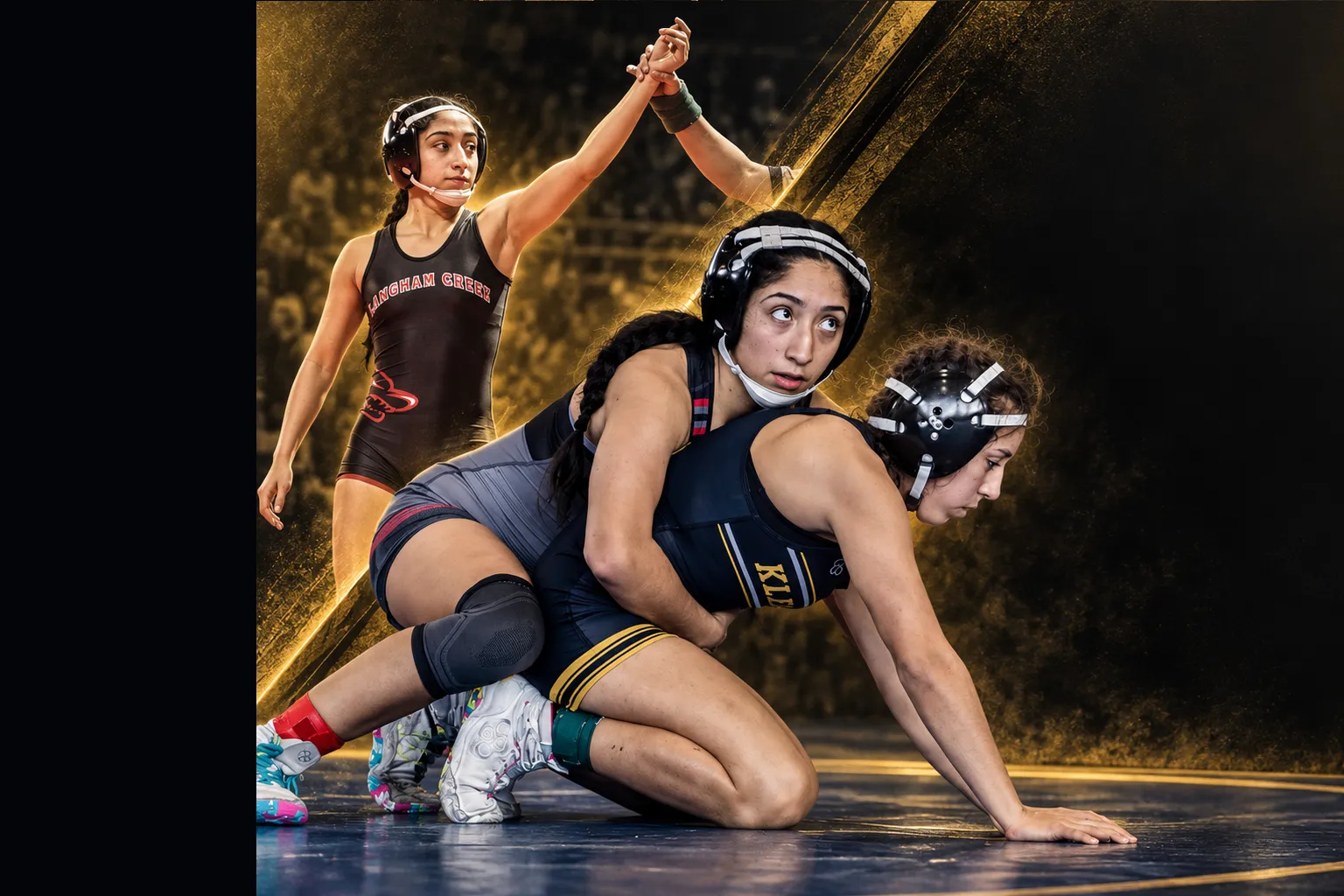
Gianna Zavala does not have the wrestling background people might expect from one of the best wrestlers in Texas.
She did not grow up traveling to national tournaments. She was not competing in youth wrestling before she reached elementary school. In fact, wrestling was not even part of her life until someone approached her during freshman orientation at Langham Creek High School.
They simply asked if she wanted to join the wrestling team.
Zavala had done jiu-jitsu a few years earlier and had thought wrestling might be something she would enjoy.
“So I thought, ‘Sure, why not? Maybe I’ll like it,’” Zavala said. “Sure enough, I had my first practice and I loved it.”
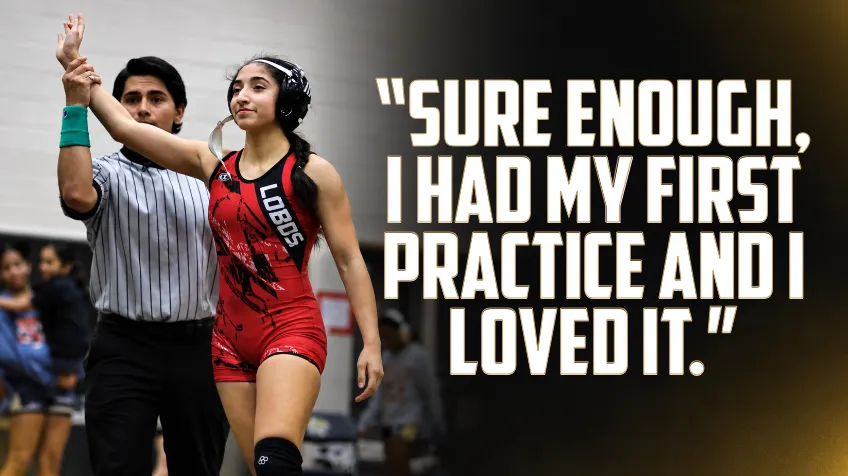
Three years later, that decision has taken her to the UIL state podium.
Zavala finished third at the state tournament as a junior, completing a remarkable rise from a wrestler who had been around .500 as a sophomore and had not even advanced to the regional tournament.
For Langham Creek coach Tommy Murray, there is a simple description for the wrestler behind that transformation.
Zavala is a “silent grinder.”
Someone who does not “search for attention, but deserves it.”
That description fits a wrestler whose progress has largely been built away from the spotlight.
Learning What It Takes
Zavala enjoyed wrestling immediately, but enjoying the sport and understanding what it takes to become elite are two different things.
She found inspiration close to home, particularly in former Langham Creek wrestler Hailey Bello.
“I always thought her technique was so good,” Zavala said. “I wanted to be able to move with the swiftness that she had when I saw her wrestle.”
But Zavala’s sophomore season showed her how much work still needed to be done.
She finished around .500 and did not advance out of the district tournament. More importantly, she came away from the season understanding that the results she wanted required a greater commitment than she had been making.
“My sophomore year, I didn’t really go to clubs or push myself during school practices, and that showed throughout my season,” Zavala said. “I wanted the results but didn’t do enough to get there.”
Instead of making excuses, she changed her approach.
After the season ended, Zavala began attending club practices almost every day. She continued that routine throughout the offseason and into her junior year.
“I started putting in the work because I knew I had the potential to make it further,” she said.
That work did not immediately make wrestling easy.
Her junior schedule was difficult, and Zavala took her share of losses while competing in tough tournaments throughout the season. There were strong finishes and signs of progress, but there were also plenty of reminders that she still had another level to reach.
One of those reminders came after another runner-up finish at the Chicken Wing tournament.
“At the time, I felt like I was constantly coming in second or being short of where I wanted to be,” Zavala said. “That loss taught me that if I wanted different results, I had to be willing to put in more work. It also taught me that I shouldn’t let losses define me as a wrestler.”
Instead, Zavala began using them as information.
She stopped worrying about becoming a completely different wrestler and focused on becoming exceptional at the positions and techniques that already fit her.
“What changed for me was really understanding the kind of wrestler I am,” Zavala said. “I started focusing on sharpening the moves I already knew worked for me. I wanted to be so confident that no matter who I was wrestling, I could rely on them and hit them when it mattered.”
The losses remained on her record.
But so did the lessons.
“Looking back, those losses showed me where I had to get better,” she said. “I think that also helped me wrestle my best at state.”
Believing She Belonged
By the postseason, Zavala was becoming a different wrestler.
She advanced through districts and then took second at the regional tournament, earning her first trip to the UIL State Championships.
For a wrestler who had not made it to regionals one year earlier, simply qualifying for state would have been an understandable reason to celebrate.
Zavala initially struggled to see herself as much more than a qualifier.
Murray saw something different.
Even after arriving at state, Zavala said she had not really pictured herself standing on the podium until her coach put the possibility directly in front of her.
“You can make it onto that podium,” Murray told her.
The message changed the way she viewed the tournament.
“After that, I knew my mindset had to change,” Zavala said. “Even though I qualified for state, I couldn’t just be happy with that. I wanted to prove to myself that I was capable of more.”

She did exactly that.
Zavala fought from behind to win a dramatic quarterfinal and secure a spot in the state semifinals.
After falling short there, she had to regroup.
There would be no championship match, but there was still an opportunity to finish the season on the podium and prove that her run was about more than one great match.
Zavala responded by defeating two difficult opponents through the consolation side of the bracket, finishing the tournament with a victory and walking away as the third-place wrestler in Texas.
One year after failing to reach regionals, she was a state medalist.
The wrestler who once wondered whether she would even like the sport had become one of the best in the state.
The People Behind the Progress
Zavala is quick to point out that the climb did not happen alone.
“My family is my number one,” she said. “They are there for me 100 percent, especially my mom and dad.”
The commitment required to become a state-level wrestler has required sacrifices from more than just Zavala.
Her parents have paid for club wrestling, driven long distances to practices and tournaments and made sure they were there when she competed.
“They’ve always found any opportunity they could to help me keep moving forward,” Zavala said. “I wouldn’t have the success I do if it wasn’t for them.”
Murray has played another important role, especially when Zavala’s own confidence has not matched her ability.
“He believes in me more than I do myself,” Zavala said. “He taught me about wrestling, but also about myself. When I doubted myself or when my mental toughness wasn’t there, he reminded me of what I’m capable of.”
The impact goes beyond wrestling technique.
“Honestly, I don’t think I’d still be wrestling without him,” Zavala said. “His belief in me helped me start believing in myself.”
She also credits Coach Justin at JFLO for constantly pushing her in practice and expanding her wrestling knowledge, along with former Langham Creek teammate and practice partner Aviana Caceres.
“She really pushed me in practice every day to get better,” Zavala said. “She was there for me during hard weight cuts and tough losses, and she was there to celebrate my wins with me.”
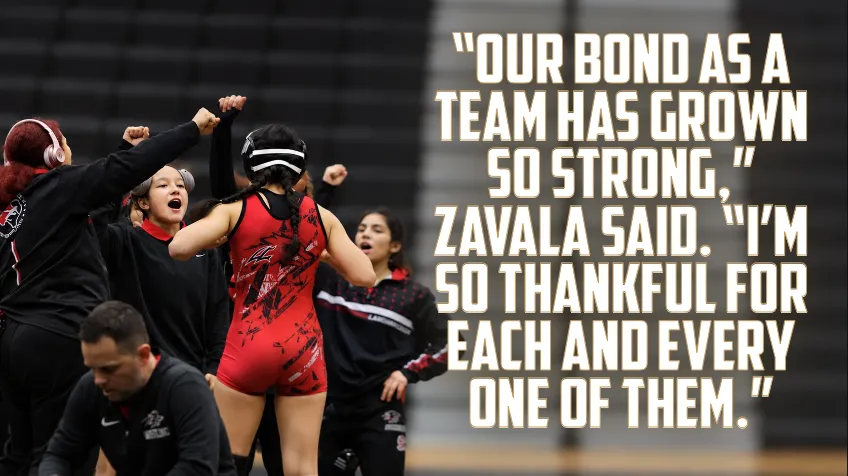
Her teammates have become another source of support.
“Our bond as a team has grown so strong,” Zavala said. “I’m so thankful for each and every one of them.”
Proof There Is Time
Zavala’s story carries significance beyond one state medal.
Texas wrestling continues to grow, and more athletes are entering high school programs with years of experience already behind them. It can be intimidating for a freshman walking into a wrestling room for the first time to look across the mat at wrestlers who have been competing since childhood.
Zavala is proof that the starting point does not have to determine the finish.
She began wrestling as a freshman.
Two seasons later, she was around .500 and could not get out of districts.
One year after that, she stood on the state podium.
There was no shortcut between those moments. There were club practices, difficult tournaments, losses, runner-up finishes, doubts and countless opportunities to decide that progress was not happening quickly enough.
She kept going.
That mindset remains one of the qualities Zavala believes separates her.
“I always believe there is someone out there working harder than me, and that motivates me to keep pushing myself,” Zavala said. “I never want to get comfortable with where I am because I know I still have many things I can improve on.”
That perspective will become even more important during her senior season.
Zavala will no longer arrive at tournaments as an unknown wrestler trying to prove she belongs.
She enters her final season as a returning state medalist and one of the wrestlers capable of making a run at a state championship.
Her goal is clear.
“I want to make it to the finals this year,” Zavala said.
The expectations are different now, and she admits that adjusting to them can be difficult.
“For me, it does get hard knowing I placed so well last year and feeling like I have to live up to those expectations,” she said. “I just tell myself that whatever happened last year doesn’t matter and that there are new goals to reach.”
It is an approach that fits the silent grinder.
Keep working.
Keep improving.
Keep looking forward.
More Than a Medal
For all the success Zavala has experienced, the reason she continues wrestling goes deeper than podium finishes.
“I wrestle because it gives me a sense of purpose,” Zavala said. “It’s one of the most rewarding things I’ve ever done, even when it’s hard.”
The sport has taught her about persistence, confidence and the difference between wanting something and doing the work required to earn it.
“Wrestling has pushed me physically and mentally and has taught me more about myself than I ever expected,” she said. “I love being able to look back and see how much I’ve grown, not just as a wrestler but as a person.”
When younger wrestlers watch her compete, Zavala hopes that growth is part of what they notice.
“I hope they see someone who is humble and calm but still knows how to compete and win in my own way,” she said. “I don’t want to feel like I have to wrestle a certain way just because that’s how someone else wrestles. I want younger wrestlers to see that you can have your own style and still be successful.”
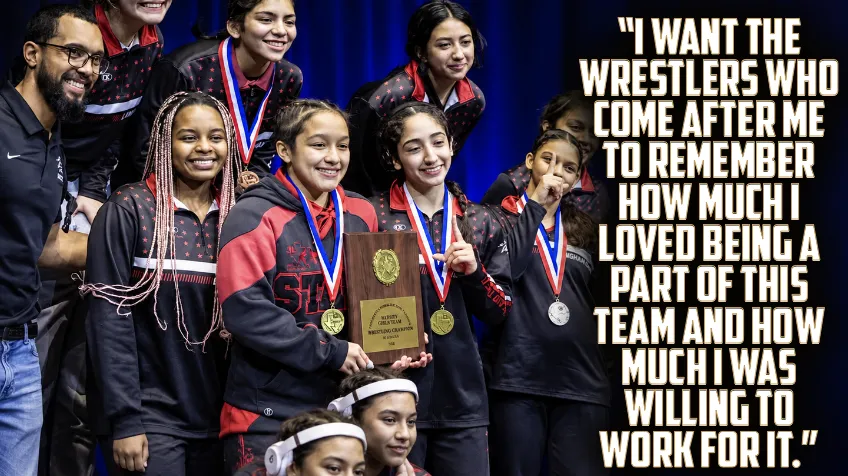
And when her final season at Langham Creek eventually ends, Zavala hopes her teammates remember more than where she finished at the state tournament.
“I want to leave behind a legacy as someone who was kind, hardworking and genuinely cared about my team,” Zavala said. “I want the wrestlers who come after me to remember how much I loved being a part of this team and how much I was willing to work for it.”
That might ultimately be the most fitting legacy for a silent grinder.
A wrestler who never needed much attention.
A wrestler who simply kept showing up.
And a wrestler whose journey from freshman beginner to state medalist now deserves to be noticed.
TRENDING ATHLETES